Wednesday, January 28, 2015

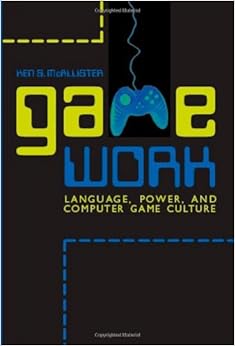
McAllister, K. S. (2004). Game work: Language, power, and computer game culture. Tuscaloosa, AL: University of Alabama Press.

Categories: Technology, Theory & Rhetoric


Summary:

McAllister's Game Work employs critical theories to investigate the computer (including all digital media mediums) game industry. His work reviews the history of the industry, the impact of economics and capitalism on society,gaming, and gamers, industry trends, balances of power, and the power struggles of the workers and the businesses producing games. He uses extensive examples from the industry to invite scholars to discuss and exploy the computer game industry and its impact on social transformation and change.

Citation-worthy: 

"The 'grammar of gameworks' proposes that one way to make meaning out of an artifact like a computer games is to see how it 'works' in five integral areas of power: agents... functions... influence... manifestation... transformative locals" (McAllister, 2004, p. 1).

“The fact that games always teach players something, makes for a conundrum: How does one comprehend the role rhetoric plays within the computer game complex when rhetoric seems to simultaneously fail and succeed in the same context?  How is it, in other words, that both anecdotal wisdom and scientific investigation conclude that computer games are both healthful and harmful? (McAllister, 2004, p. 16)

“The answer… is that the computer game complex [or any number of other circumstances] is dialectical, a complicated and ever-changing system constructed out of innumerable relationships among people, things, and symbols, all of which are in turn connected to other vast dialectical system: the entertainment industry, the high-tech business, capitalism, articulations of democracy and freedom, and so on.  By recognizing that the computer game complex is dialectical, those who set out to make sense of how meanings are constructed within and about it –that is, people who are investigating the computer game complex’s rhetorics –will necessarily do this work mindful of the fact that their perspectives may be very different than others’.  This does not mean that all perspectives are equally valid; some people are better informed than others (McAllister, 2004, p. 16).”

"Agent/developes, as we have seen, regularly negotiate at some level of consciousness at least three contradictions inherent in the computer gaming industry: 1. Computer games are an art form based on mass production; 2. Computer games often seem to encourage unhealthy kinds of play; 3. Computer games require developers to design realistic games that aren't really realistic" (McAllister, 2004, p. 129).

"Computer games do real work in the world. They change lives, not just those of game players, marketers, and developers, but increasingly those of everyone. ... As globalization ... pries open international borders in order to capture new markets, radical social transformations follow close behind. Gratuitous and grpahic representations of violence in computer games are disturbing, there is no doubt. The hypersexualization adn objectification of the human form in games is similarly problematical, as are the multitude of racial and cultural stereotypes that are designed into the. ... But as long as those agents who participate in the process of how games mean--developers, marketers, adn player--ignore the long-range implications of their work and fail to ask about the interests being served by the making, selling, and playing of artifacts like computer games, then the small redresses that are made to lend credibility to the computer game complex... will accomplish little in the way of enabling a spirit of play to flourish in the lives of everyone who works within it (McAllister, 2004, p. 169). 


Tuesday, January 27, 2015

Dyer-Witherford, N. & de Peuter, G. (2009). Games of empire: Global capitalism and video games. Minneapolis, MN: University of Minnesota Press.

Categories: Technology, Theory & Rhetoric


Summary: 

Ten years after addressing power stuggles on the Internet in Cyber-Marx, Dyer-Witherford brought his approach to autonomist Marxist theory to video games. These games, Dyer-Witherford and de Peuter argue, allow individuals to experience a variety of different perspective, from the humble plumber Mario, to the roll of a god controlling worlds. The variety of these experiences influence the thinking of the gamers, making them more aware. Companies and corporations recognized such opportunities to influence the gamer audience, and the Marxist power struggle continues to cycle into the imaginary universes created in video games. In their unabashedly anti-capitalism approach, they redefine Empire and other terms (such as Immaterial Labor, pp. 4-6; Playbor Force, pp. 23-26; Cognitive Captialism, chapter 2; Biopower, chapter 6; etc.) to suit their needs and beliefs, exploring the concepts in the field of electronic gaming. They also explore: the machine's influence and participation in these cycles of struggle, the impact of virtual reality on reality, the effect of war, the ability for games to merge different cultural groups (such as rap culture and gamer culture), imprisonment through and in gaming, and political and cultural simulation through video games.

Well-written and grounded in examples, this work will appeal to those already of a similar ideological mindset of the authors, while those in opposition will find the same concerns and problems that have been stated elsewhere in hundreds of debates on the subject. The authors defend their position, but their lack of a balanced approach (indeed other ideologies are merely insulted instead of addressed through the work) leaves room for improvement in the work.

Citation-worthy:

"Games once suspect as delinquent time wasters are increasingly perceived by corporate managers and state administrators as formal and informal means of training populations in the practices of digital work and governability" (Dyer-Witherford & de Peuter, 2009, p. xix).

"Empire [is] encapsulated [in] a wider experimental fusion of Marxist militancy and poststructuralist theory. It circulates novel concept--biopower, immaterial labor, multitude, exodus--among students of globalization" (Dyer-Witherford & de Peuter, 2009, p.xxi).

"We work with a revised and modulated version of Empire. By Empire, we mean the global capitalist ascendancy of the early twenty-first century, a system administered and policed by a consortium of completitively collaborative neoliberal states ... to  an increasingly dubious preeminence" (Dyer-Witherford & de Peuter, 2009, p.xxiii).


Monday, January 26, 2015

Creswell, J. W. (2013). Research design: Qualitative, quantitative, and mixed methods approaches. Thousand Oaks, CA: Sage.

Category:  Research Methods


Summary:

The author's explaination was straightforward and accurate. "This book advance[d] a framework, a process and compositional approaches for designing qualitative, quantitative, and mixed methods research in the human and social sciences" (Cresswell, 2013, p. xix). Cresswell succeeds in his endeavor with amazing clarity. Any potential researcher could benefit from the precise definitions, processes, outlines, and suggestions he provided.

Author's note: I am omitting the "Citation-worthy" section in this post because this book would be of better use on a bookshelf than summarized on a blog. It is more a reference manual than scholastic, theoretical work. I highly suggest purchasing it if you are looking for "how-to" research. Trying to put the most helpful quotations down would copy a majority of the text.


Saturday, January 24, 2015

Garrison, D. R., & Shale, D. (1987). Mapping the boundaries of distance education: Problems in defining the field. American Journal of Distance Education, 1(1), 7-13.

Categories: Theory & Rhetoric, Technology

Summary and Citations:

In 1986, Keegan published a descriptive definition of distance education. "He concluded that distance education is characterised by: the quasi-permanent separation of teacher and learner throughout the length of the learning process; this distinguishes it from conventional face-to-face education; the influence of an educational organisation both in the planning and preparation of learning materials and in the provision of student support services; this distinguishes it from private study and teach-yourself programmes; the use of technical media (print, audio, video, or computer) to unite teacher and learner and carry the content of the course; the provision of two-way communication so that the student may benefit from or even initiate dialogue; this distinguishes it from other uses of technology in education; the quasi-permanent absence of the learning group throughout the length of the learning process so that people are usually taught as individuals and not as groups, with the possibility of occasional meetings for both didactic and socialisation purposes (Keegan, 1986, p. 49)" (Garrison & Shale, 1987, pp. 7-8).

Garrison and Shale's analyzed Keegan's definition of distance education. They concluded that "Keegan's definition is too restrictive in its view that distance education is an industrialized form of learning. [That] his definition leads to a characterisation of distance education that is unnecessarily bounded by past practices" (Garrison & Shale, 1987, p. 12).

They argued that "there are three criteria essential for characterising the distance education process -- two of which are really corollaries of the first. Although the second and third logically follow from the first, they are necessary to clarify the distance education process. 1. Distance education implies that the majority of educational communication between (among) teacher and students occurs noncontigously [not touching or in contact with]. 2. Distance education must involve two-way communication between (among) teacher and student(s) for the purpose of facilitating and supporting the education process. 3. Distance education uses technology to mediate the necessary two-way communication" (Garrison & Shale, 1987, p. 11).


Borchers, T. A. (2006). Rhetorical theory: An introduction. Long Grove, IL: Waveland Press.

Categories: Theory & Rhetoric


Summary:

The book is aptly named; it meets its objective as an introduction to rhetoric and rhetorical theory by defining important terms, presenting topics in the field, and providing a history of the philosophers and scholars of the field. The author also meets the aim of writing book's target audience: undergraduates.

Citation-worthy: 

"Basically, rhetoric includes words, images, and gestures presented to an audience for some kind of purpose. Rhetoric is usually thought to include the content of those words, images, and gestures as well as the style or form in which they are presented… Rhetorical theory is, essentially, explanations for how rhetoric works and what it does" (Borchers, 2006, p. 5).

"An anonymous book, the Rhetorica ad Herennium, written in ancient Rome during the first century B.C.E. provides us with an operational definition of rhetoric. This book identifies the five canons of classical rhetoric: invention, arrangement, style, memory, and delivery. Rhetoric is created as a result of these five processes. Invention refers to the discovery of ideas about which someone speaks. Thinking of a topic, focusing your thoughts, and deciding how to prove your ideas are all elements of invention. Arrangement refers to the order, or structure, of ideas presented by the speaker. Style includes the words and manner of speaking used. Memory refers to how the speaker remembers what will be said. (In ancient times, writing and printing technology were not widely available, so speakers had to create other ways of remembering their ideas.) Finally, delivery includes the speaker's vocal characteristics and physical mannerisms. At this point you have no doubt recalled your instruction in a public-speaking class, which was probably based on the five cannons" (Borchers, 2006, p. 6).

"Rhetorical theorist Kenneth Burke used the word identification as a synonym for communication. In 1969, he defined rhetoric as "the use of language as a symbolic means of inducing cooperation in beings that by nature respond to symbols" (Burke, 1969b, p. 43). Cooperation is achieved when a speaker and audience identify with each other. There is some give and take by both the speaker and audience for cooperation, or identification, to be achieved. Thus, Burke is interested in receivers, or audience members, and their perception of rhetoric. Burke's focus on symbolic communication and cooperation marked a departure from previous ways of viewing rhetoric. For Burke, symbols are the essential element of rhetoric; he downplayed other aspects in order to understand the full power of symbols on how we relate to others" (Borchers, 2006, p. 7).

"Foss and Griffin (1995) present us with the definition of rhetoric that focuses on the relationship between the person producing rhetoric and his or her audience. They define rhetoric as invitational rhetoric, which is "an invitation to understanding means to create a relationship rooted in  equality, immanent value, and self-determination" (p. 5). As we continue, keep in mind that rhetoric is practiced by a variety of people who have very different orientations to the world" (Borchers, 2006, p. 7).

"Communication scholar Thomas Farrell (1976) highlights several important elements of rhetoric in the following definition: "a collaborative manner of engaging others through discourse so that contingencies may be resolved, judgments rendered, action produced" (p. 83). Ferrell broadened his definition by using the word "discourse," which presumably includes nonverbal forms of communication as well. Farrell's definition is also useful for us because it focuses on the collaborative nature of rhetoric and its uses.… Farrell was interested in rhetoric as a social act that is shared between two or more people to accomplish something" (Borchers, 2006, p. 7).

"Rhetoric… involves symbols— Verbal and/or nonverbal — and it is concerned with coordinating action between individuals. Rhetoric helps us make choices, and it is created in the interaction between unique individuals. Most important, a culture's conception of rhetoric is unique to that culture. As cultures change, so too do conceptions of rhetoric" (Borchers, 2006, p. 8).

"The word rhetoric often refers both to the symbols that are used in communication as well as to the theory about those symbols… To clarify what is meant by rhetoric, however, we'll use the term to designate the symbols used by people to communicate. We might also refer to this sort of communication as rhetorical practice on occasion. We'll call the person doing the communicating the rhetor. The term rhetorical theory will be reserved for theories that describe rhetorical practice. Rhetorical theorist will be used for a person who created a particular rhetorical theory" (Borchers, 2006, p. 8).

"Rhetorical criticism is the process of using rhetorical theory in order to understand and evaluate rhetorical practice and generate future rhetorical theory. Rhetorical criticism is the method used by rhetorical researchers, whereas social scientific researchers use surveys, experiments, or ethnography. Rhetorical critics are people who practice rhetorical criticism… Rhetorical theory is useless without the practice of rhetoric and application of theoretical principles. In essence, rhetoric invites theorizing about its principles, strategies and effects. Accordingly, rhetorical theory is used to critique rhetoric so that rhetors have a better understanding of its impact. Consequently, new rhetorical theory is developed or existing theory is modified through the critical application of rhetorical principles" (Borchers, 2006, pp. 8-9).

"Characteristics of rhetoric [are]…
– symbolic...
– involves an audience...
– establishes what is probably true...
– inventive and analytic" (Borchers, 2006, p. 9).

"Limits of rhetoric… For each issue, you might think of a continuum, a line with two divergent ideas upon which there are many intermediary points. Some theorists hold extreme views on these issues, but other theorists fit somewhere in the middle of the continuum…
– Is rhetoric limited to persuasion?
– Is rhetoric intentional?
– Is rhetoric comprised only of words?
– Is rhetoric limited to public at dress?
– Is rhetoric concerned with propositions or style or both" (Borchers, 2006, p. 14).

"Pragmatic-dominant rhetorical theory… Ancient theorists from Greece and Rome who asked and answered very pragmatic questions about rhetoric and who saw the speaker as influencing the events of the world through rhetoric" (Borchers, 2006, p. 19).

"Rhetoric was used during this period [Middle Ages] to embellish the truth or ingratiate the rhetor to a very small audience. That is, attention was paid to the aesthetic qualities of rhetoric, which is a way of referring to rhetoric's style. Rhetoric during this period consisted of sermonmaking and the art of letter-writing. Rhetors wrote beautiful letters in order to show that they were worthy of positive judgment (Scott, 1975, p. 444)" (Borchers, 2006, p. 20).

"Scientific discoveries would shape the role of rhetoric in the time period Scott discuss his next, the pragmatic-subordinate. Rhetoric would come to play a pragmatic role in the 1700s-1800s, but it would be subordinate to science. That is, rhetoric would be used to communicate what science had found. The world, as discovered through science, would be the dominant element and the speaker would receive secondary emphasis during this time" (Borchers, 2006, p. 20).

"As we explore contemporary rhetorical theory, you'll see how an increasing effort is made to understand the interaction of speaker and audience. Whereas the meaning of words was mostly taken for granted during the earlier periods, we'll spend a great deal of time as we study contemporary rhetoric discussing understanding, misunderstanding, and how audiences perceive a speaker's messages. Rhetorical theory during this period also attempts to reduce human conflict, although Scott did not see this as a defining characteristic of contemporary theory" (Borchers, 2006, p. 20).

"Rhetoric is concerned with what is probably true in a given culture at a given time. The statement refers to epistemology, the study of knowledge or ways of knowing. Although theorists more or less agree that rhetoric creates what is accepted as knowledge, or truth, some theorists see rhetoric as playing a greater role in the creation of knowledge than others" (Borchers, 2006, p. 23).

"The rhetorical theory of the period lasting from approximately 400 B.C.E. to 100 C.E. is often called classical rhetoric. The primary purpose of rhetoric during this time was persuasion" (Borchers, 2006, pp. 30-31).

"Parts of the speech. Cicero, who believed that arrangement was one of the most important aspects of rhetoric, identified seven parts to a speech:
– The entrance, to introduce the subject and assure the audience of the speaker's right intentions
– The narration, which provides background information about the topic at hand
– The proposition, or the speaker's thesis
– Division, which outlines the main concepts, or points, of the speech
– Confirmation, or the supports for the claims made in the speech
– Rebuttal, which is an attempt to overcome potential disagreements
– Conclusion, or the synopsis of evidence and final appeal to the audience's emotions" (Borchers, 2006, p. 48).

"The sublime, according to Longinus, is the use of language to momentarily lift the audience members outside of themselves. He defined the sublime as "the process by which we may raise our natural powers to a required advance in scale" (On the Sublime, section I). The sublime was not an appeal to logic, or even emotion, but an appeal to the stylistic and aesthetic subtleties of the audience. Longinus traced the sublime to the speaker's use of language: "subliminity is always an eminence and excellence in language" (C-section I).
The sublime has a powerful impact on audience. In fact, Longinus placed the sublime ahead of logical, pathetic, or ethical appeals" (Borchers, 2006, pp. 59-60).

"Rationes dictandi outlined the five key parts of a letter:
Salutatio, which was the salutation
– Benevolentiae captiatio, which made the reader "attentive and well-disposed to the writer" (Conley, p.  94).
– Narratio, which included the facts on which the letter was based 
– Petitio, in which the rhetor made a request of the reader
Conclusio, or the closing" (Borchers, 2006, p. 69).

"Correctness refers to consistently using the proper standard when evaluating items of beauty. Blair explained, "a man of correct Taste is one who is never imposed on by counterfeit beauties; who carries always in his mind that standard of good sense which he employs and judging everything (p. 24). Delicacy is an innate trait, while correctness can be learned" (Borchers, 2006, p. 75).

"Blair explained that style has two qualities: perspicuity and ornament. He explains… Perspicuity,... is using language in a way that clearly states the speaker's idea… Perspicuity has three qualities: purity, propriety, and precision. Purity refers to using words that are "of the language which we speak" and not "imported from other Languages" (Blair, 1965, p. 216). We might consider this today to mean that a rhetor is to use words that are commonly understood, not exotic words or slang words which do not have designated meanings. Propriety means to use the right word. A rhetor's words should be "correct" and "significant." Propriety, then, refers to the specific words chosen by the rhetor to communicate a specific idea. Precision avoids superfluous words and expressions and gets to the point of the speaker's idea...A speaker should avoid saying more than he or she intends to have precision" (Borchers, 2006, p. 76).

"A second element of style is ornament. We have previously said that ornament concerns how words are pleasing and interesting for hte listener. Ornament is achieved through graceful, stron, or melodious sentences or by figurative language. A graceful sentence has unity, which means that "There must always be some connecting principles among the parts" (Blair, 1965, p. 216). That is, a sentence should discuss one idea, should have a consistent tense and voice, and should be a complete unit of thought" (Borchers, 2006, p. 77).

"In the early 1600s, the scientific study of rhetoric evolved into a systematic study of argumentation" (Borchers, 2006, p. 87).

"Another contribution to rhetorical theory is Bacon's theory for the four fallacies of reasoning.… First, the Idols of the Tribe relates to inherent limitations in the nature of humans to reason and attain knowledge. Despite the fact that voters have their own areas of expertise, very few of us have the ability to understand the full range of economic, social, and international issues that are involved in voting for a presidential candidate. We are inherently limited in our
 ability to understand all the issues of an election campaign.
Second, the Idols of Cave points to individual traits that prevent knowing. We are biased, prejudiced, and/or incapable of grasping certain concepts and ideas…
Third, the Idols of the Marketplace refers to problems inherent in language that prevent clear communication.…
Fourth the Idols of the Theatre refers to fallacies in philosophy and theory that obscure experiential ways of knowing. That is, we are limited by the theoretical and conceptual frameworks we use to make sense of our world.…each of Bacon's idols refers to limitations in our ability to know something" (Borchers, 2006, pp. 89-90).

"Celeste Condit (1995) and other rhetorical theorists use the term linguistic reflexivity to refer to the "intellectual orientation that entails constant reflection on the forces of language as they are at work in what one hears and what one speaks" (p. 209). In other words, rhetorical theory turns its attention in this chapter to role and influence of language and how we communicate" (Borchers, 2006, p. 115).

"Ogden and Richards (1928) identified context as being one of the key reasons why people have different interpretations of symbols" (Borchers, 2006, p. 119).

"Kramarae (C 1981) explained that a woman's presence as a rhetor is not "always fully acceptable" (p. xiv) and that women face disadvantages when they communicate with men. Kramarae said women are a "muted group" because the language of our culture does not serve women as well as it does men. Women cannot express themselves as well as men because the words we use have been formulated based on the male experience. That is, women are "muted" in our culture. Women, she argued, have different experiences and require different words than our language contains in order to express themselves. Because of language, women are forced to see the world through the experiences of men and communicate using male words. Women are "muted" because they cannot easily express their perspective and experiences" (Borchers, 2006, p. 130).

"Humans use narrative rationality when evaluating the stories they hear, which is based on two standards: narrative probability and narrative fidelity. Narrative probability asks whether the story is consistent with itself. Narrative fidelity evaluates the degree to which the individual components of the story "ring true" with the audience. Narrative rationality depends not entirely on rules of logic but also on the values that are part of decision-making. This is an important part of Fisher's theory. Let's consider these standards in greater detail" (Borchers, 2006, p. 161).

"Narrative probability concerns the degree to which the story "hangs together." In other words, the standard looks at whether the story makes sense by itself. Fisher (1987) argues that stories must have structural coherence, material coherence, and characterological coherence. Structural coherence refers to whether the story contradicts itself. A witness who testifies in court and says something different than he or she had previously said would not have structural coherence. The story would not "hang together." Material coherence refers to how well the story accounts for facts that are known to be true. A witness who testifies that the car in the accident was green, when all the other witness claim it was red it would not have material coherence. Characterological coherence questions the reliability of the characters in the story. A witness accused of murder but who is claiming innocence would be difficult to believe if he or she did not display some emotion about being accused.… The second standard of Fisher's (1987) narrative paradigm is fidelity. Whereas coherence refers to the integrity of the story, fidelity refers to the individual components of stories and the degree to which these components make sense to the audience. Thus, probability concerns the story itself and fidelity refers to the connection between the story in the audience" (Borchers, 2006, pp. 161-162).

"Critical approaches to rhetoric...the word "critical," in this sense, refers to a concern for power and ideology as expressed through rhetoric" (Borchers, 2006, p. 172).

"Ideographs are words or phrases that are "pregnant" with ideological commitment – for example, "liberty," "rights of privacy," or "religion"" (Borchers, 2006, p. 182).

"That's the core of universal pragmatics are speech acts and how those speech acts can be challenged to come to rational understanding. A speech act is a statement that accomplishes something or does something. A threat is an example of a speech act. When you make a threat, you enter into an implicit contract by which you pledge to take some action if someone else doesn't take one. Habermas (1979) outlined three types of speech acts: constatives, regulatives, and avowals. Constatives are used to search the truth or falsity of something. When you say that it is cold outside, you're using a constative. Regulatives are used to influence someone else. You use regulatives when you make a promise or issue a command. Avowals are used to express the speaker's feelings or emotions, such as saying "I am sad."
Constatives, regulatives, and avowals are measured against certain standards. Constatives must be truthful. Habermas (1979) wrote that the intention of the speaker does not matter. What matters is the "truth of the proposition" (p. 58). Regulatives must be appropriate given the interpersonal relationship between the speaker and listener. A student, for example, cannot demand that an instructor give a certain grade for an assignment. Such command is not appropriate for the relationship. Avowals must be sincere expressions of the speaker's feelings. If I say that I am sad, that statement must be a genuine reflection of my mood" (Borchers, 2006, p. 187).

"Rhetorical theorists contend that images are replacing words as the primary form of rhetoric in our culture today. These changes in how rhetoric is practiced have made it necessary to re-examine our theories of rhetoric, revise them when necessary, and develop new theories to better explain the dominance of media and images on how we think about what is true, what is real, and what is ethical.
Our central argument in this chapter is that media have had a strong influence on the way rhetoric is practiced and on the theories that have been developed to explain rhetoric" (Borchers, 2006, p. 255).

"Today, rhetors communicate with a more intimate style, one more characteristic of the personal, informal, and intimate medium of television (figure 10.1). This rhetorical style, which Kathleen Jamieson (1988) has called electronic eloquence, has, according to Jamieson, five characteristics: it is personalized, self-disclosive, conversational, synoptic, and visually dramatic" (Borchers, 2006, p. 263).

"Like our ideas of what's true, the theorists of media rhetoric challenge our ideas about what it means to be human. That is, there is an ontological dimension to the study of rhetoric and media. In this sense, McLuhan, perhaps, makes the strongest argument when he claims that a medium is an extension of our senses. That is, human experience and our conception of what it means to be "real" is directly linked to the media we use to experience the world. We are different beings when we use different media. Ong's work, too, has an ontological dimension. He believes that human consciousness is linked to the type of media culture in which one lives. That is, our very way of thinking and feeling is linked to the dominant media of our culture" (Borchers, 2006, p. 279).

"The postmodern movement has also had a significant impact on how rhetorical theorists have conceived of rhetorical practice. In particular, postmodernist have explored the link between the symbols and words they mean. The implications of their investigation influences the most fundamental questions about knowledge, identity, and ethics" (Borchers, 2006, p. 281-282).

"Modernization is "a term denoting those processes of individualization, secularization, industrialization, cultural differentiation, commodification, urbanization, bureaucratization, and rationalization which together have constituted the modern world" (Best and Kellner, 1991, p. 3). Lucaites and Condit (1999) add, "in the modern worldview, the universe is a relatively simple, stable, and highly ordered place, describable in and reducible to absolute formulas that hold across contexts" (p. 11). For academic researchers and theorists, social discord, according to Lucaites and Condit, is cured by "greater research, less passion, more rationality, and more education" (p. 11). Put simply, the use of supposedly objective research methods were thought to provide adequate explanation for social life and offer solutions to problems humans faced during the modern era" (Borchers, 2006, p. 282).

"Postmodernism views with skepticism those definitive statements about that nature of knowledge, truth, ontology, or ethics" (Borchers, 2006, p. 283).

"Hill's analysis was met by discussion from other rhetorical experts, who claimed that objectivity was next to impossible and that rhetorical critics should embrace their biases and perspective in their analyses" (Borchers, 2006, p. 284).

"Foucault theorized that power relations were not always apparent. Individuals who have power didn't always know the ways that they could exercise their power" (Borchers, 2006, p. 289).

"Nelson (1996) offers a 16-point "manifesto" of cultural studies beliefs and practices.… Some of the most instructive:
– Cultural studies involves more than a "close reading" of nonliterary cultural text. Instead, cultural studies has a history and literature that must be considered when one person forms a "cultural studies" critique
– Cultural studies does not necessarily have to concern itself with artifacts of popular culture
– Cultural studies may make use of semiotics — which we studied in chapter 10 — but it is not synonymous with semiotics. Cultural studies instead is concerned with cultural context on the politics of signification, a process we will discuss later in this chapter.
– Cultural studies is concerned with the production, reception, and uses of cultural text, not necessarily their internal characteristics
– Cultural studies considers the relationships between texts, objects, and cultural forces. The focus is not on the text in isolation from culture, but rather on a text's operation within a cultural structure
– Cultural studies does not provide a "fixed, repeatable methodology" that can be used over and over again on cultural phenomena
– Cultural studies criticism suggests future courses of action for members of a culture
– Academic disciplines that teach cultural studies must take seriously the politics of disciplinarity. It is not enough to simply rename a class or department "cultural studies" without a commitment to how the unique cross-disciplinary nature of cultural studies fits within the university framework" (Borchers, 2006, p. 309).

"Signification is the study of the production of meaning. We shouldn't assume that meaning is fixed or set in any way. There is a kind of symbolic work or practice that goes on to give meaning to things. Signifying practices are practices involved in the production of meaning" (see Jhally, 1997). Media are widely used systems of signifying. Talking with other people is another way in which signifying practices occur. Often, however, a medium such as computer technology takes the place of face-to-face communication and becomes very widespread. Questions of power arise in this discussion. Hall says we should ask "who has the power to circulate which meanings to whom?" (See Jhally, 1997). To answer this question, one must consider the economic system in which message producers exist. It is difficult today to separate news organizations, for example, from their business of producing profit.
It is important to look not only at what is communicated but also add what is absent from communication" (Borchers, 2006, p. 314).

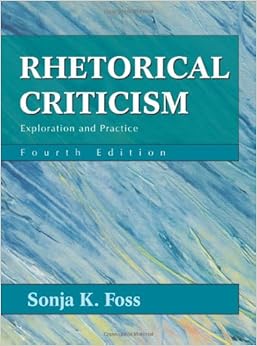
Foss, S. (1996). Rhetorical criticism: Exploration & practice. Prospect Heights, IL: Waveland Press.

Category: Theory & Rhetoric


Summary:


Foss's work provides the foundational introduction to various theories of rhetorical criticism in a practical and useable manner that could be used by both those new to the field and those needing a refresher course. In each section she teaches the theoretical basis for a theory, then outlines the process for performing the specified criticism, how to present the results, and cautions or limitations inherent to the theory. Examples conclude each section to provide insight or potential discussion in a graduate seminar class. Very helpful for preparing works for publication that use rhetorical criticism.

Citation-worthy:

"Rhetoric is defined as the human use of symbols to communicate. This definition includes three primary dimensions: (1) humans as the creators of rhetoric; (2) symbols as the medium for rhetoric; and (3) communication as the purpose for rhetoric" (Foss, 1996, p. 3).

"The standards used in rhetorical criticism to judge analyses of artifacts are rooted in two primary assumptions. One assumption is that objective reality does not exist. As discussed in Chapter 1, those of us who study rhetoric believe that reality is constituted through the rhetoric we use to talk about it; it is a symbolic creation. Thus, the artifact you are analyzing does not constitute a reality that can be known and proved. You cannot know what the artifact "really" means because there are as many realities about the artifact as there are vocabularies from which to conduct inquiry about it. A second assumption on which the standards of rhetorical criticism or built is very much related to the first: a critic can know an artifact only through personal interpretation of it. You cannot be objective, impartial, and removed from the data because you bring to the critical task particular values and experiences that are reflected in how you see and write about an artifact. As a result of these assumptions, your task as a critic is to offer one perspective on an artifact – one possible way of viewing it. You are not concerned with finding the true, correct, or right interpretation of an artifact. Consequently, two critics may analyze the same artifact, ask the same research questions, and come up with different conclusions, and the essays they write both can be excellent essays of criticism" (Foss, 1996, p. 17).

"Wicheln's major contribution to the development of neo-Aristotelianismwas that he listed the topics that should be covered in the study of a speech. A critic, he suggested, should deal with these elements: the speaker's personality, the public character of the speaker or the public's perception of the speaker, the audience, the major ideas presented in the speech, the motives to which the speaker appealed, the nature of the speaker's proofs, the speaker's judgment of human nature in the audience, the arrangement of the speech, the speaker's mode of expression, the speaker's method of speech preparation, the manner of delivery, and the effect of the discourse on the immediate audience and it's long-term effects" (Foss, 1996, pp. 21-22).

"At the same time that artifacts are functioning to provide equipment for living for audiences, they are revealing the world view or what Burke calls deterministic screens of the rhetors who created them" (Foss, 1996, p. 64).

"In cluster criticism, the meanings that key symbols have for a rhetor are discovered by charting the symbols that cluster around those key symbols in an artifact" (Foss, 1996, p. 65).

"The fantasy-theme method of rhetorical criticism, created by Ernest G. Bormann, is designed to provide insights into the shared worldview of groups. Impetus for the method came from the work of Robert Bales and his associates in the study of communication in small groups. Bales discovered the process of group fantasizing or dramatizing as a type of communication that occurs in groups... Bormann extended the notion of fantasizing discovered by Bales into a theory (symbolic convergence theory) and a method (fantasy-theme criticism) that can be applied not only to the study of small groups but also to all kinds of rhetoric in which teams function dramatically to connect audiences with messages.… Symbolic convergence theory is based on two major assumptions. One is that communication creates reality. As Chapter 1 describes, reality is not fixed but changes as our symbols for talking about it change. A second assumption on which symbolic convergence theory is based is that symbols not only create reality for individuals but also individuals' meanings for symbols can converge to create a shared reality or community consciousness" (Foss, 1996, p. 97).

"Generic criticism is rooted in the assumption that certain types of situations provoke similar needs and expectations in audiences and thus call for particular kinds of rhetoric. Rather than seeking to discover how one situation affects one particular rhetorical act, the generic critic seeks to discover commonalities in rhetorical patterns across recurring situations. The purpose of generic criticism is to understand rhetorical practices in different time periods and in different places by discerning the similarities and rhetorical situations and the rhetoric constructed in response to them—to discover "how people create individual instances of meaning and value within structured discursive fields." As rhetors develop messages, genres influence them to shape their materials to create particular emphases, to generate particular ideas, and to adopt particular personae. Similarly, audience members' recognition of a particular artifact as belonging to a specific genre influences their strategies of comprehension and response" (Foss, 1996, p. 137).

"Purpose in generic description is to define a genre and formulate theoretical constructs about its characteristics. Generic description involves four steps: (1) observing similarities in rhetorical responses to particular situations; (2) collecting artifacts that occur in similar situations; (3) analyzing the artifacts to discover if they share characteristics; and (4) formulating the organizing principle of the genre" (Foss, 1996, p. 141).

"Generic participation determines which artifacts participate in which genres. This involves a deductive process in which you test an instance of rhetoric against the characteristics of a genre. Generic participation involves three steps: (1) describing the perceived situational requirements, substantive and stylistic strategies, and organizing principle of a genre; (2) describing the perceived situational requirements, substantive and stylistic strategies, and organizing principle of an artifact; and (3) comparing the characteristics of the artifact with those of the genre to discover if the artifact belongs in that genre" (Foss, 1996, p. 143).

"When rhetorical critics are interested in rhetoric primarily for what it suggests about beliefs and values, their focus is on ideology. In an ideological analysis, the critic looks beyond the surface structure of an artifact to discover the beliefs, values, and assumptions it suggests" (Foss, 1996, p. 209).

"In contrast to the view of metaphor as decoration, metaphor now is seen as a major means for constituting reality. We do not perceive reality and then interpret or give it meaning. Rather, we experience reality through the language by which we describe it; description is the reality we experience. Metaphor is a basic way by which the process of using symbols to construct reality occurs. It serves as a structure in principle, focusing on particular aspects of a phenomenon and hiding others; thus, each metaphor produces a different description of the "same" reality....The metaphors "we select to filter our perceptions and organize our experience" are important because "when you choose a metaphor you are also choosing its rules, along with the roles and scripts that those rules dictate. Metaphors contain implicit assumptions, points of view, and evaluations. They organize attitudes toward whatever they describe and provide motives for acting in certain ways.… The point is that, with the selection of a different metaphor, we would view and experience arguments differently" (Foss, 1996, pp. 268-269).

"Narrative criticism… Narratives can be distinguished from other rhetorical forms before characteristics. Primary defining feature of narrative discourse is that it is comprised of at least two events.… A second characteristic of the narrative is that the events in it are organized by the time order. A narrative is not simply a series of events arranged randomly – it is at least a sequence of events. The order does not have to be chronological and may involve devices like flashbacks and flashforwards, but at least the narrative tells in someway how the events relate temporally to one another....A third requirement for a narrative is that it must include some kind of causal or contributing relationship among events in the story. Narratives depict change of some sort, and this third requirement defines the nature of that change by stipulating  the relationship between earlier and later events in the story… A fourth requirement for a narrative is that it must be about a unified subject… Symbols other than narratives, of course, help us structure of the world in very much the same way that stories do. But stories or narratives do so in a unique way. A narrative is substantially different from a set of instructions, an argument with a claim and evidence, definition, or contract, for example. What makes it different is that the narrative creates for both the storyteller and the audience a personal involvement in the narrated world and the active narrative" (Foss, 1996, pp. 307-308).

"Pentandic criticism is rooted in Burke's notion of dramatism, the label Burke gives to the analysis of human motivation through terms derived from the study of drama. Two basic assumptions underlie dramatism. One is a language use constitutes action, not motion. Motion corresponds to the biological or animal aspect of the human being, which is concern with bodily processes such as growth, digestion, respiration, and the requirements for the maintenance of those processes — food, shelter, and rest, for example. The biological level does not involve the use of symbols and thus is nonsymbolic.
In contrast, action corresponds to the neurological aspect of the human being, which Burke defined as the ability of an organism to acquire language or a symbol system. This is the realm of action or the symbolic. Some of our motives are derived from our animality — as when we seek food to sustain our bodies. Others, however, originate in our symbolicity, as when we strive to reach goals in arenas such as education, politics, religion, and finance. Even our desires in such arenas arise from our symbol system" (Foss, 1996, p. 355).

"Burke elaborates on his notion of action at the heart of dramatism by establishing three conditions for action. One is that action must involve freedom or choice. If we cannot make a choice, we are not acting but are behaving mechanically… A second condition necessary for action is purpose. Either consciously or unconsciously, we must select or will a choice – we must choose one option over others. Motion is a third requirement for action. While motion can exist without action (as when an object falls, through the force of gravity, to the ground), action cannot exist without motion. Symbolic activity or action is grounded in the realm of the non-symbolic" (Foss, 1996, pp. 355-356).

"Most seasoned rhetorical critics, however engage in rhetorical criticism using a different process… As useful as the formal methods of criticism are for discovering insights into rhetoric, they do not always allow what is most interesting and significant in an artifact to be captured and explained. In most cases, then, you want to analyze artifacts without following any formal method of criticism. This kind of criticism is generative in that you generate units of analysis on explanation from your artifact rather than from previously developed, formal methods of criticism" (Foss, 1996, p. 387).

Friday, January 23, 2015

Palloff, R. M., & Pratt, K. (2011). The excellent online instructor: Strategies for professional development. Hoboken, NJ: John Wiley & Sons.

Categories: Communication Design, Technology, Theory & Rhetoric


Summary:

Many books discuss the building, promoting, best practices, design, and aministration of online education. Palloff & Pratt take a different approach by focus on creating a culture of training within a school offering online education, all while building a sustainable competent faculty. If applied--assuming instructor buy-in (which they share strategies to accomplish)--their principles would drastically improve a school struggling with poor online instruction.

Their formula for success centers on identifying what stage of online instructional development a teacher is at, establishing training, forming mentor/coach relationships, then connecting training and success to rewards or evaluation. The beauty of their work was how well they addressed the problems administrators and department heads will likely encounter, along with both theoretical and proven methods for eliminating such difficulties.

Palloff & Pratt's research uncovered multiple weaknesses in the current focus on best practice band-aids in online instruction that ignore some of the following significant issues: "Faculty are rarely given the level of training and support they need to begin teaching online [and are] ... confused about how to get started. Training continues to be focused on the technology in use instead of how to teach in the online environment. ... Faculty are busy and often do not participate fully in training. Faculty lack familiarity with the tools of online teaching. Often faculty are brought in last-minute to teach a ... course. Faculty training takes too much time. ... Faculty resist mandatory training. ... Faculty resist constructivist approaches to training. Training should not be a one-shot experience but should be ongoing. The goals of training are rarely clear" (Palloff & Pratt, 2011, pp. xii-xiii).  

They begin with discussions of what constitutes excellent online instruction. Then they focus on the attributes of superior online instructors. The ability to recognize such talent is crucial to their mentor-based mentality. Palloff & Pratt then show how to increase the readiness of an instructor to teach online, decrease faculty resistance, eliminate technophobic Luddite fears, and motivate individuals through a structure of support. They then discuss what training options exist, and prioritize them according to effectiveness based on various situations.

The second part of the book outlines the training, with recommendations for certification programs, community-learning approaches, dealing with obstacles to training, and efficient training. The mentoring engine drives their approach, moving those with no experience instructing online to eventually become mentors themselves. This process is intriguing because in helps remove some of the attitudes of us vs. them that can arise between teachers and administration.

The final stage connects faculty development with evaluation to ensure proper administrative rewards and feedback occur. The authors conclude with a unique and original best practices list: best practices for developing online instructors.

Though instructors could benefit from many areas of this book, it is primarily a text for management, administration, and training. One final point, the rich appendixes (resources for faculty developers and resources for faculty, resources for administrators) should not be overlooked! 

Citation-worthy:

"Little to no attention is being paid to what makes online teaching effective — only what can be done in a pinch to get course material online so that students or faculty who are ill can continue to be involved in classes" (Palloff & Pratt, 2011. p. XII).

"Training of online instructors has not kept pace with the demand for excellence in the online environment, a demand voiced by students and administrators alike" (Palloff & Pratt, 2011. p. XIII).

"Akridge, DeMay, Braunlich, Collura, and Sheahan (2002) suggest that student retention online is dependent on three factors: selecting the right students for the right program; using a high learner-focused delivery model; and engaging learners at a personal level. Hebert (2006) discovered that the responsiveness of faculty to perceived student needs helps increase persistence in online courses and creates a greater degree of satisfaction with the learning process. In other words, good instructors and instruction are the strongest marketing tools an online program can have" (Palloff & Pratt, 2011. p. 4).

“We noted that much of the literature on best practices in online teaching was…effective use of various technologies" (Palloff & Pratt, 2011. p. 5).

"Based on Weimer's (2002) work on learner-focused teaching, in order to achieve all of this, we note that several things need to happen:
– The balance of power needs to change — the instructor online acts as a learning facilitator, allowing students to take charge of their own learning process.
– The function of content needs to change — as noted by Carr-Chellman and Duchastel (2001), good online course design makes learning resources and instructional activities available to students rather than providing instruction in the form of a lecture or other means.
– The role of the instructor needs to change — by establishing active and strong online presence, a topic we will return to in more depth, the instructor demonstrates his or her expertise and guides the students in their learning process.
– …Students need to take more responsibility for their own learning process.
– The purpose and process of assessment on the valuation need to change—…Consequently other forms of assessment, such as self-assessment and application activities, should be incorporated to assess student learning" (Palloff & Pratt, 2011. p. 6).

"Establishing a presence is the process of demonstrating to others who we are in the online environment, as well as making social connections with others who share that environment with us. It is the concept of visibility… And is critical to students in perceiving that the instructor is paying attention to them and their learning needs" (Palloff & Pratt, 2011. p. 7).

“Wenger (1999) notes that the social aspects of education are the most important and need attention before delving into the exploration of content" (Palloff & Pratt, 2011. p. 9).

"The learning community, then, becomes the vehicle through which the course is effectively conducted" (Palloff & Pratt, 2011. p. 9).

"Some of the key elements that define excellence in online teaching are:
– The excellent online instructor understands the differences between the face-to-face and online teaching and can effectively implement them into development and facilitation of online classes.
– The excellent online instructor is committed to this form of teaching and uses the online environment to his or her advantage in delivering an online class.
– The excellent online instructor is able to establish presents early in the course and encourages students to do the same.
– The excellent online instructor is highly motivated and in turn is a good motivator for students.
– The excellent online instructor understands the importance of community building and devotes time at the start of the class to that function.
– The excellent online instructor promotes interactivity between students through development of good discussion questions that engage them and encourage them to seek out response material on their own.
– The excellent online instructor incorporates collaborative work into the design and delivery of an online class.
– The excellent online instructor respects students as partners in the learning process.
– The excellent online instructor is active and engaged throughout the course, providing timely, constructive feedback throughout.
– The excellent online instructor is open, flexible, compassionate, responsive, and leads by example" (Palloff & Pratt, 2011. pp. 13-14).

"A model of phased faculty development for online teaching…includes:
– Developing and establishing presence
– The incorporation of classroom experiences and student feedback into faculty development
– The use of mentors and champions
– Advanced development — the development of lifelong learners" (Palloff & Pratt, 2011. p. 17).

"The criteria for the excellent online instructor include:
– Visibility — the excellent online instructor can establish presence and is present frequently in the online environment.
– Compassion — defined by openness, concern, flexibility, fairness, and honesty — the excellent online instructor expresses sincere positive regard for students and delivers student-focused, student-centered instruction.
– Communication — the excellent online instructor communicates with students frequently, provides substantial feedback, and communicates well using technology.
– Commitment — the excellent online instructor is only not only a passionate and committed teacher, but sees the value in teaching online and sees the facilitated model of teaching as rigorous and powerful. The excellent online instructor is motivated and a good motivator.
– Organization — the excellent online instructor is organized and a good time-manager" (Palloff & Pratt, 2011. p. 19).

"Faculty do not achieve excellence online in their first course" (Palloff & Pratt, 2011. p. 19).

"The phases of online faculty development… We have identified five distinct phases, which we have called:
– Visitor — those faculty who have toyed with the idea of technology integration in the face-to-face classes and who may have posted the syllabus or assignments online or used e-mail for assignment completion.
– Novice — those faculty who have never taught online and who may or may not have taken an online course as a student but have consistently posted a syllabus online and have used some communications technologies to supplement their face-to-face teaching.
– Apprentice — those faculty who have taught online for one or two terms. They may have taught more than one course per term. They are developing an understanding of the online environment and the skills required to teach online.
– Insider — those faculty who have taught more than two semesters online and have taught more than one course per term. They feel comfortable in the online environment, are proficient with course management technology, and have basic understanding of the skills needed for online teaching. They may have designed one or more online courses.
– Master — those faculty who have taught online for multiple terms and have designed several online courses. They have mastered the technology required to teach online and are likely to have integrated technology beyond the course management system into their teaching. They feel extremely comfortable with the skills required to teach online and can be called upon for peer support for newer online faculty" (Palloff & Pratt, 2011. p. 20).

"There are four categories of need that we believe are present in each phase [of faculty development]… They are:
– Personal – focusing on the instructor as a person and including such elements as establishing a presence on developing confidence in one's ability to teach online.
– Pedagogy — focusing on the skills and techniques involved with teaching online and an online scholarship, including an understanding of the theories that undergird online teaching and the ability to develop an online learning community.
– Content — focusing on the discipline the faculty member represents and how that's content is best disseminated online.
– Technology — focusing on the development of skill with the course management system in use, choosing technologies that meet learning objectives, as well as adjunct technologies that might be incorporated into the development of an online course as well as teaching.
The categories of need do not necessarily hold equal weight through the developmental phases" (Palloff & Pratt, 2011. pp. 20-21).

"Assign more experienced online faculty to mentor or coach new faculty as they design or deliver, or both, their first online classes. This is not done as part of administrative evaluation of faculty, but as a way to ensure quality, improve performance overtime, answer immediate questions as they arise, and provide new online faculty members with someone they can access quickly as problems and concerns emerge" (Palloff & Pratt, 2011. p. 29).

"Caffarella (2002) summarizes the major principles of adult learning theory that should be taken into account when planning training for faculty:
– Adults learn best when their experience is acknowledged and new knowledge is built on past knowledge and experience.
– Adults are both intrinsically and extrinsically motivated to learn.
– All adults have preferred ways of learning and processing information.
– Adults are not likely to participate in learning situations unless they are meaningful to them.
– Adults are pragmatic in their learning and want to directly apply what they are learning.
– Adults come to learning situations with personal goals and objectives that might not align with the plan goals and objectives.
– Adults prefer to be active rather than passive learners.
– Adults learn using collaborative and interdependent means, as well as independently.
– Adults are more receptive to learning when it occurs in environments that are physically and psychologically comfortable for them" (Palloff & Pratt, 2011. p. 36).

"Key points in training for excellence
– Don't use cookie-cutter approaches to faculty training — offer, instead, a flexible schedule and a menu of topics that address the continuum of faculty experience from novice to master.
– Use approaches based on adult learning theory — active approaches that combine individual and collaborative engagement work best.
– Honor experience! Apprentice training is for novices and apprentices, not experienced or master faculty who are changing institutions.
– Use best practices in online teaching and training approaches — model those practices so that faculty can incorporate them into their own courses seamlessly.
– Incorporate cycles of learn, do, reflect into training, allowing faculty to learn about a new skill, practice it, and then reflect on the results" (Palloff & Pratt, 2011. pp. 43-44).

"Sherry, Billig, Tavalin, and Gibson (2002) studied and presented what they termed the technology learning/adoption trajectory model and proposed training strategies that accompanied each phase in the model. They discuss the following phases and strategies:
– Stage one. Teacher as learner: termed and information gathering stage, instructors are seeking to develop the skills they need in order to perform instructional tasks using technology. Recommended training includes demonstrations of best practices using technology delivered by peers who are already incorporating technology into teaching.
– Stage two. Teacher as a doctor: this is an experimental stage in which instructors try out various forms of technology and share their experiences in doing so with a focus on task management. The use of mentors and knowledgeable peers, as well as lab situations, is recommended to support instructors in their experimentation.
– Stage three. Teacher as co-learner: a clear relationship between technology and the delivery of curriculum is forming at this stage. It is at this point that workshops focusing on enhancing instruction through the use of technology are recommended, along with collegial sharing of lesson and assessment ideas. Students can be effectively used as technical assistants in this phase.
– Stage four. Teacher as reaffirmer or rejector: greater awareness of learning outcomes is developing in this phase, along with the ability to determine the impact of various technological approaches on student learning. Incentive systems work well at this phase, including encouragement to disseminate exemplary student work as examples of the impact of technology on student progress and performance.
– Stage five. Teacher as leader: experienced instructors are encouraged to extend their roles in this phase to become active researchers and teach new members. Instead of participating in training at this phase, instructors are encouraged to lead workshops and work as mentors" (Palloff & Pratt, 2011. pp. 48-49).

"Rarely are adjuncts offered ongoing training for online teaching and rarely are they brought into decisions regarding program structure and design, governance, and the like. The result is a rather disconnected and isolated faculty body with little insight into how to get help when needed, how to deal with difficult students, or how to seek additional training should that be desired" (Palloff & Pratt, 2011. p. 58).

"Chuang, Thompson, and Schmidt (2003) reviewed the literature on technology mentoring programs for faculty and found that all programs and approaches discussed included several common elements: providing visions for technologies; individualizing technology support; breaking down hierarchal structure; establish an open dialogue and collaborative relationships; providing mutual benefits for mentors and mentees; and emphasizing the creation of a learning community for those participating in the program" (Palloff & Pratt, 2011. p. 65).

"When non-hierarchical models are employed for mentoring, the result is often increased levels of mutual respect and trust (Chuong, Thompson, & Schmidt, 2003). It is not uncommon to see mentees engaging in collaborative work with one another as they become more comfortable in the use of technology" (Palloff & Pratt, 2011. pp. 66-67).

"Developing an effective mentoring program:…

"Plan the program. The first step in implementing a mentoring program on campus or at a distance is to incorporate the program into the strategic plan for the institution or the strategic plan for technology integration.… Begin with mentor training. Regardless of the form the program takes, those who will serve as mentors on a formal or informal basis need training and preparation before they are called upon to mentor.… "Market" and evaluate the program. Novice and beginner faculty who are entering online teaching need to know what training they will be expected to complete, as well as the nature of the mentoring program they are entering.… As mentioned, the most effective mentoring program will contain elements of one-to-one mentoring, with mentors either chosen or assigned; group mentoring; and mentoring through a developmental network" (Palloff & Pratt, 2011. pp. 70-73).

The mentor program format is as follows: Mentor training: Create mentor directory… Mentors train novice and beginner faculty… Faculty learning community emerges… One-to-one mentoring… Peer group mentoring… Developmental networks formed… Ongoing training and development for all faculty… New group of mentors trained (Palloff & Pratt, 2011. p. 73).

"Zachary (2000) talks about the importance of creating a sustainable mentoring program. She contends that in order to do so, the organization or institution needs to embed mentoring an organizational culture that values continues learning. She presents ten signs that indicate that a mentoring culture is present:
– Accountability — with an eye toward continuous quality improvement, the mentoring program is evaluated regularly, progress is benchmarked, and results are communicated.
– Alignment — mentoring is embedded in the culture and not seen as an additional activity; high priority is placed on learning.
– Demand — people want to participate in the program as mentors or mentees and seek out both informal and formal opportunities to do so.
– Infrastructure — human and financial resources support the program.
– A common mentoring vocabulary — people throughout the organization speak positively about the program, value mentoring experiences, and seek out additional resources and opportunities for learning.
– Multiple venues — a combination of mentoring options are available.
– Reward — bonuses and stipends offered to mentors; recognition for participation occurs.
– Role modeling — excellence in mentoring is visible in the organization and successes are publicly shared.
– Safety net — support is readily available.
– Training and education — training and education are strategically linked as part of an overall plan; skill building and renewal training for both mentors and mentees as part of the program (pp. 178-179)" (Palloff & Pratt, 2011. p. 74).

"Virtual school programs can be fully online or hybrid or blended approaches. There are three main models used: blended, supplemental, and classroom-based (Van Dusen, 2009):
– Blended models. Often used by charter schools are in homeschooling approaches, the blended model allows students to work from home and online classes for the majority of their work, but students to come into a face-to-face classroom setting with the same instructor for a short period each week.
– Supplemental models. This approach allows school districts or multiple districts to fill in curricular gaps through the use of online courses. In this case, students are predominantly in the face-to-face classroom but may take an online course or two in order to move beyond what might be offered at their school. In general, this approach has been used to fill the gaps caused by budget cuts, which have predominantly affected the ability to offer electives, advanced placement courses, language courses, and the like. In addition, supplemental models have been used for the provision of summer school programs and for credit retrieval for students who are in need of credit toward graduation.
– Classroom-based models. This approach focuses on technology integration in the face-to-face classroom. However, it goes beyond simply using technology to enhance classroom delivery by potentially using purchased online courses delivered in the classroom or by engaging all students online while in the face-to-face environment" (Palloff & Pratt, 2011. p. 80).

"The National Education Association (NEA, n.d.) summarizes the characteristics of excellent online teachers as follows:
– Are prepared to use information, communication, course management systems, and learning tools and use them effectively
– Are motivated self-starters who can work well with minimal supervision
– Are student-centered and flexible
– Are focused on maintaining high standards
– Are able to promote and sustain an online learning community
– Are able to facilitate collaborative learning
– Are able to collaborate with other teachers, support staff, and students to promote student success and participation online
– Are able to specify learning objective and design authentic assessments to measure them
– Possess a sense of humor and can project their personality by developing an online voice (what is described in the online literature as the ability to establish presence)
– Communicate effectively in writing
– Have completed professional development courses and activities specifically geared to online teaching" (Palloff & Pratt, 2011. p. 81).

“By participating in online training on a number of topics, teachers can gain the experience of being an online student while gaining a deeper understanding of what online pedagogy requires. Online classes aimed at preparing veteran teachers to teach online can also serve this dual purpose" (Palloff & Pratt, 2011. pp. 82-83).

"Angelo and Cross (1993) suggest that instructors ask themselves three questions when evaluating their own courses: what are the essential skills and knowledge I am trying to teach? How can I find out whether students are learning them? How can I help students learn better? Responses to these questions point directly to the outcomes developed for the course and look at how successful the course activities were in helping students master them" (Palloff & Pratt, 2011. p. 92).

"Arbaugh (2000) suggests that the impact of the course management system in use affects the ability of the instructor to deliver a high-quality learning experience online. He believes that there are four general categories of factors that influence online learning and should thus be incorporated into evaluation of online courses:
– Perceived usefulness and ease of the course
– Flexibility for students and instructors
– Ease of an emphasis on interaction
– Experiences with engagement" (Palloff & Pratt, 2011. pp. 92-93).

"What we conclude from all of this is that faculty will be motivated to teach online and engage in faculty development efforts to advance their work if they feel welcomed by the institution, wanted, needed, and supported. Faculty evaluation needs to be built on a solid understanding of online learning" (Palloff & Pratt, 2011. p. 101).

"A survey conducted by Alan and Seamen (2007) reveals that more than two-thirds of higher education institutions in the United States are offering some form of online education. In addition, 69% of traditional and non-traditional universities believe the student demand for online courses will continue to grow. As of 2007, 83% of the institutions already offering online courses expected their enrollments in these courses to continue to increase. Based on this level of demand, it is clear that the need for experienced faculty to teach these classes is huge and that institutions needed to develop plans for recruiting, hiring, training, developing, and supporting online faculty (Green, Alejandra, & Brown, 2009)" (Palloff & Pratt, 2011. p. 104).

"Vignare (2009) notes that faculty satisfaction is tied to two elements — choice and preparedness. If the faculty are forced into the online environment, they are less likely to engage fully or design learning experiences that fit well online, whereas faculty who choose to teach online and who are given sufficient time, training, and support to do so are more satisfied with the outcome and simply do a better job of teaching online" (Palloff & Pratt, 2011. p. 106).

"The components of a training plan, then, should minimally include:
– Identification of needs and interests
– Determination of what individuals, groups, or training courses or programs can meet those needs
– Creation of a developmental network to address individualized needs
– Informal networks of faculty engaged in online teaching
– Formal or informal mentoring" (Palloff & Pratt, 2011. p. 111).